Spanish for professionals in NYC.So — let's talk.
Private lessons, online or walking through the city, built around where you'll actually use it.
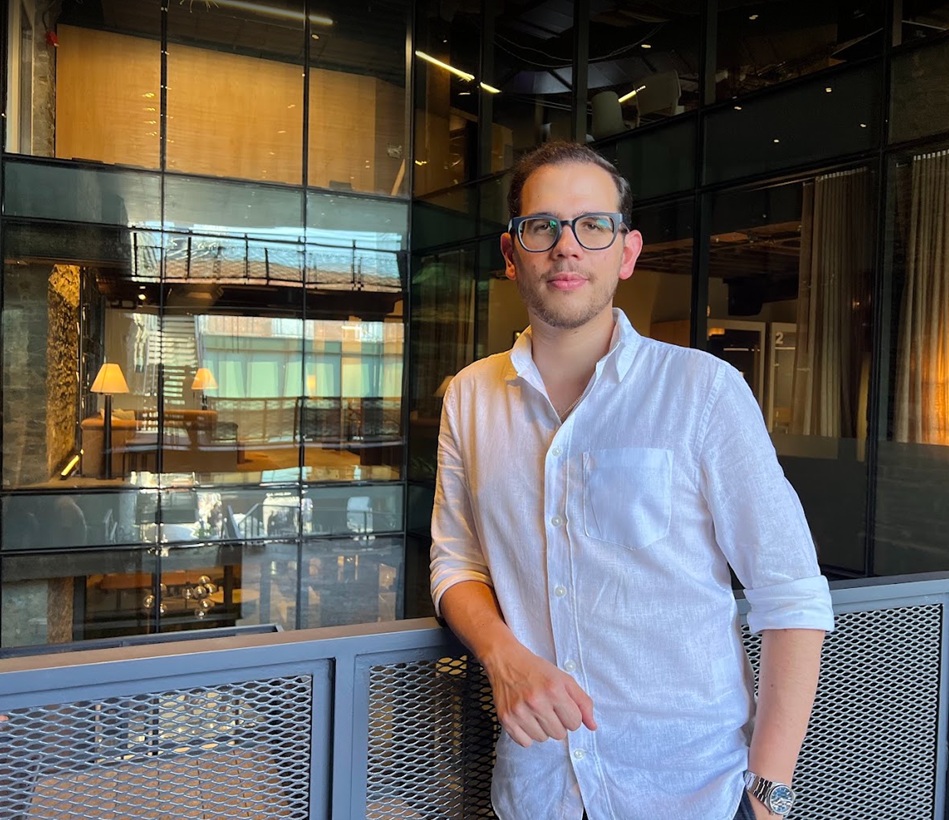
I come from Venezuela, where I studied literature — language and its capacity to build worlds — and began by teaching Spanish and history. That work took me to a university classroom, then to Colombia for four years, and since 2022 to New York.
I teach the way an artisan works. Each student is a different world, with their own interests and their own reasons, and the lessons are built from those. I teach through your mistakes rather than around them: grammar arrives when you need it, not before. You speak from the first lesson, and you keep speaking until it stops feeling like translation.
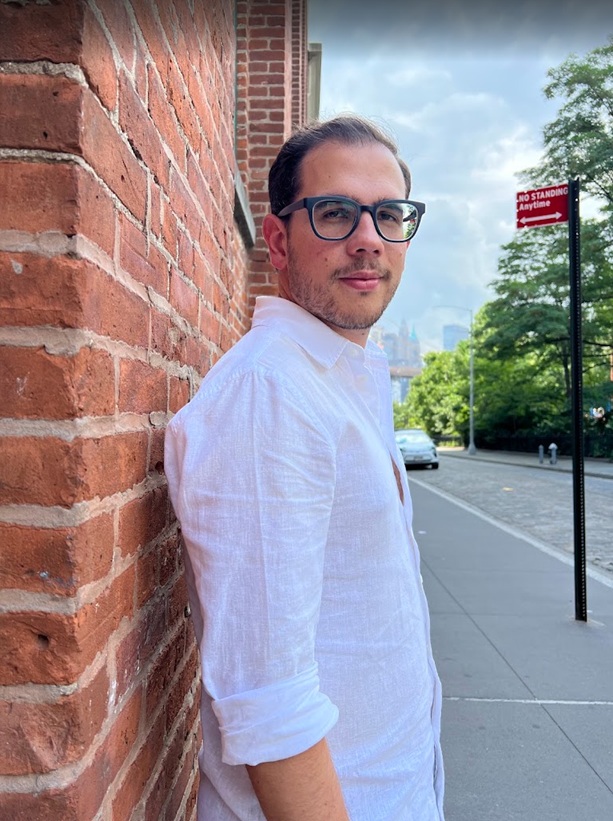
Spanish, claro. Pero chévere.
There is no single standard Spanish. Mine is the Spanish of New York — fed by every accent that lives here, and by the vocabulary you'll actually hear on the street.
I choose my students carefully. This works for people who need the language for something real: clients, patients, colleagues, a promotion, a family they want to speak to properly.
Some of my students understand every word their parents, aunts and grandparents say, and still go quiet at the table on Christmas or at a birthday. That is not a beginner. That is someone who has the Spanish of home and needs the Spanish of speaking up.
Método Ocando
What happens in a lesson
We start by talking. Whatever your level, you already know something — the lesson begins there, not on page one of a book.
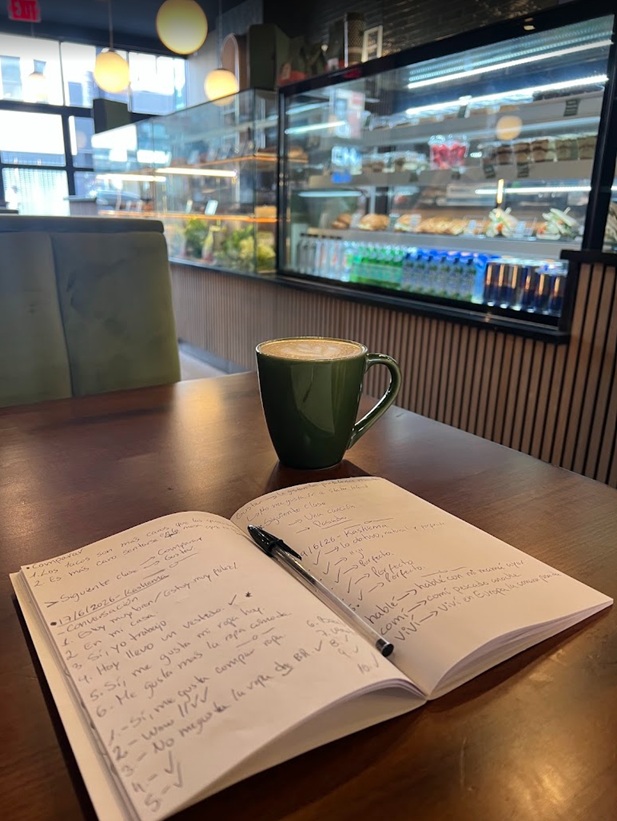
Then you keep talking, longer than you expect to. This is the part most lessons skip, and it is the part that does the work. While you speak, I write. The notebook that goes everywhere with me is not decoration; it is a clinical instrument.
What you got wrong is the lesson. I don't arrive with a grammar point scheduled for week three. I arrive with your sentences from last week, and we work on what you were actually trying to say. Grammar earns its place here — it isn't assumed.
Materials come last. Texts, videos, exercises, all of them mine, built for your level and your interests. They're there to fix what we worked on, not to introduce it.
One-on-one attention · Correction without interruption · Culture beyond clichés · Patient progress · Real contexts · No crash courses
A student speaking Spanish · Unscripted · A1.1 · Four lessons in
Hola! I'm at JFK returning from Peru. As a surgeon with little time I love learning Spanish with Josué because I get the most out of my time with a tailored experience that fits my learning style and level. Right balance of feeling good about my skills and challenge.
Luma
Before I taught, I studied. I learned English and Italian, so I know exactly how it feels to know the answer and not say it — and how much worse that feels at forty than at fourteen.
My students tell me the same thing. Ordering at a restaurant. Starting a conversation. Answering a question they could have answered. The fear of sounding foolish is a normal stage of learning a language, and it is the reason most adults stop practicing the moment the lesson ends.
Luma is where you practice without an audience. I set the topic from what we covered in class, so you're never reaching for words you haven't met yet. You talk. No one is watching.
Afterward, I see how it went — where you hesitated, what you steered around, what came out easily for the first time. Then the next lesson starts there.
A session runs ten to twenty minutes, depending on the week you're having. This is New York; some weeks there is no hour to give. Ten minutes of speaking is worth more than a lesson you postpone.
Walking Lessons
Some lessons happen outside. Where we go depends on you.
We've walked Jackson Heights, where Colombian and Ecuadorian sit on the same block. We've spent an afternoon at the Hispanic Society in Washington Heights, reading paintings instead of pages. We've eaten our way through Little Spain, where the Spanish is from Spain and sounds nothing like the rest.
What we study is decided by what we pass. A menu taped to a window, a sign for a service, a price argued over at a fruit stand — the vocabulary arrives on its own, in the order the street gives it. I don't plan the lesson. I plan the route.
This is also where the idea of one correct Spanish falls apart. No textbook holds a city like this, because no textbook can decide which version is standard.
You order your own food. That is usually the hardest part of the first walk, and the part students remember.
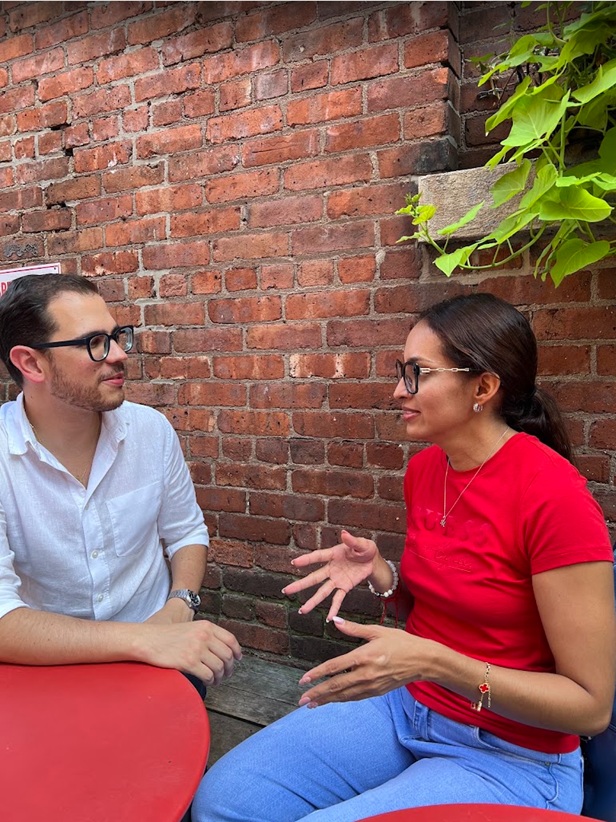
The Hispanic Society · Washington Heights
Online — $50 / hour
Structured, conversation-first, and consistent. Most students do their steady weekly work here.
In person / walking — $90 / hour
The city does part of the teaching. Limited by geography and by the hours I have.
Josué uses an immersive approach that goes beyond just vocabulary and grammar, really focusing on how the language is spoken in real-life situations.
Hourly
| Online | $50 / hour |
|---|---|
| In person or walking | $90 / hour |
| Public sector and community | $40 / hour, online |
Lessons are booked by the hour, and you can pay for one at a time. Plenty of students work that way — their weeks don't look the same twice, and a fixed block would be a fiction. The packages are there if you'd rather commit to a stretch of work: they cost less per hour, and whatever you don't use comes back to you.
Plans change. A lesson can be moved with four hours' notice.
For social workers, public defenders, community health workers, teachers, and people at nonprofits serving Spanish-speaking New Yorkers.
This rate exists because of who you're going to speak Spanish with. A caseworker who can hear a family without an interpreter in the room is doing something with the language that I want to be part of. That's worth a different number to me.
If in-person lessons would work better for you, tell me in the application and we'll figure it out.
Packages
| Package | Online | In person | Public sector (online) |
|---|---|---|---|
| 8 sessions | $400 | $720 | $320 |
| 16 sessions | $750 | $1,350 | $600 |
On the sixteen-session block, the sixteenth is on me.
8-session packages are valid for 4 months. 16-session packages are valid for 8 months.
Admission consultation
Free · Twenty minutes
Before we start, we talk. Twenty minutes, in English and in Spanish, so I can hear where you are and you can hear how I teach.
It isn't a lesson and I won't teach you anything in it. It's how I decide whether I'm the right person for what you need — and how you decide the same about me.
How this works
I hold a specific hour for a specific person. When a lesson is cancelled late, that hour doesn't go to anyone else — there's no waiting list I can call with four hours' notice. That's the whole reason for the terms below.
Cancellations
Cancel at least four hours ahead and we reschedule, no charge. It happens; it's fine.
Cancel with less than four hours and the lesson counts as taken. The same applies if the same lesson is rescheduled and then cancelled again.
If you don't show up and haven't written, the lesson counts as taken.
If the weather makes a walk unworkable, we move online that same hour at the online rate, and the difference goes back to you.
If I'm the one who cancels — whatever the notice — the lesson doesn't count and we find another time. That's my problem, not your money.
Pausing a package
If you're travelling or away for more than three weeks, tell me and we'll pause the block. Paused sessions extend the window; they don't disappear.
Refunds
Prepaid packages can be refunded at any time for whatever you haven't used.
Sessions you've already taken come off at the standard hourly rate rather than the package rate, since the package price is for committing to the whole block. Sessions left unused past that window aren't refundable.
If you buy 16 online sessions for $750 and take two before deciding to stop, you get back $750 − (2 × $50) = $650.
Payment by Zelle or bank transfer, before the block begins.
Inside the workshop
I make my own materials. Not out of principle — out of necessity. Nothing on the market is built for a barber from Santiago and a construction worker from Puebla to be arguing in the same apartment, which is exactly the Spanish my students need to follow.
These are animated stories I write and produce for my lessons. Six characters share an apartment in New York: Ecuador, Colombia, Puerto Rico, Venezuela, Mexico, the Dominican Republic. Each one speaks the way people actually speak where they're from, which means they don't always sound alike, and occasionally they don't understand each other either.
That's the point. There is no single standard Spanish. Mine is the Spanish of New York — six countries on one block, all of them correct.

Apply for lessons
I teach fifteen private students at a time. Ten places are open right now, and they don't turn over often.
The form takes about six minutes and asks real questions — what you need Spanish for, what has gone wrong before, what you expect from a teacher. I read every one myself, and I answer within a few days either way.
If you're someone who has wanted to learn Spanish but feels nervous or intimidated, he creates an environment where you can learn at your own pace, make mistakes, ask questions, and actually enjoy the process.